Phoenix: South Central Light Rail Extension
 Valley Metro is the public transportation agency in the Phoenix region providing bus, streetcar, light rail and paratransit services.
It is currently in the midst of a major light rail expansion program that will add approximately 40 new miles to the existing system. One of those expansion projects, the South Central Extension/Downtown Hub, is a 5.5-mile extension that will connect South Central Phoenix to the existing light rail system in downtown Phoenix. The project, expected to be completed in 2025, will have eight stations and a park and ride lot with 110 parking spaces.
This project includes landscaping, ticket vending machines, traction power buildings, train signals, and new vehicles. As part of construction, Valley Metro will renovate and reconstruct the facilities disrupted by light rail construction, such as street surfaces, sidewalks, curbs and gutters, traffic signals, utilities, storm drainage, and landscaping.
The utility work is extensive. For every linear foot of trackway installed, six linear feet of wet utilities (including water, sewer and storm drains) will be removed, relocated or upgraded. That does not include all the other affected third-party utility lines, such as power, electricity, telephone, gas and cable.
Key Project Milestones
2013: Alternatives analysis completed.
2016: Environmental assessment published.
2019: Construction began with utility work.
2021: City of Phoenix, Valley Metro and FTA entered into full funding grant agreement.
The method of project delivery for the light rail extension is construction manager at risk (also known as construction manager / general contractor). Design-build is being used for one project element, the expansion of the agency’s Operations and Maintenance Center.
Table of Contents
Project Team
The project management team for the South Central extension includes a project manager, manager of construction and utilities, deputy director of corridor development, representative from the agency’s contracts and procurement department, project controls specialist, and City of Phoenix representative.
The project manager’s duties include:
- establishing scope, budget and schedule
- leading communication across various divisions
- overseeing consultants and contractors
- coordinating design reviews
- overseeing construction change process
- coordinating assigned activities with other departments and outside agencies
This document refers to the following Valley Metro staff.
- Trevor Collon, deputy director of design & construction
- Luis Mota, project manager for the South Central Extension project (also chief executive manager of the Infenix, LLC consulting company)
- Tony Santana, project manager for the Northwest Extension Phase II project
- Julie Landspurg, manager in the Human Resources Department.
Organization Chart

Project Team: Descriptions
 Trevor Collon
Eno interviewed Trevor Collon when he was Valley Metro’s deputy director of design and construction. He was responsible for overseeing the design and construction of all the agency’s rail expansion projects. (In 2024, Collon was promoted to chief of capital development).
Collon has extensive civil engineering and managerial experience. After graduating college with an engineering degree, he worked for consulting firms on numerous projects including managing contracts with the U.S. Army Corps of Engineers and leading a design team in India. He then took a full-time position as project manager for the City of Mesa, where he oversaw various capital improvement projects including roadway, utilities, and light rail extensions. He joined Valley Metro in 2019 as manager of capital development.
Since the South Central project is being led by a consultant project manager, Eno asked Collon his thoughts about balancing agency staff and consultants on a project team.
Collon said, “it’s good to have the manager of design and the senior rail engineer on staff because they can protect the design quality, and they know where the bodies are buried.” If those positions are filled by consultants, he explained, the agency could lose valuable institutional knowledge, such as remembering issues and problems raised by property owners and stakeholders. That type of information might not make it into drawings or meeting minutes. Collon said the “Great Retirement” in the early 2020s was a “double whammy” because the agency lost both people and institutional knowledge.
Because of the challenges associated with hiring qualified employees, retaining skilled professionals, and properly sizing in-house staff for a dynamic capital program, the agency has had to rely on consultants for many positions. Collon acknowledged that “managing the program and maintaining key staff has been a struggle.” All the resident engineers on the agency’s large projects are currently consultants. These engineers also some manage most of the day-to-day aspects of construction and work with contractors.
Collon talked about the relationship with Valley Metro’s construction contractors. Some he said, put “their logos behind them and look out for what’s in everyone’s interests.” With others, he noted, “There’s more distrust. We have to strike a balance. We still need to partner with them. Their crews are laying tracks and pouring concrete. We can’t be at a point where we’re constantly threatening claims and lawsuits.”
Collon referred to the South Central extension as “our most extensive undertaking since the original 20-mile system was built and opened in 2008.”
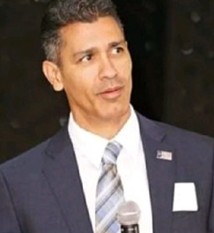 Luis Mota
Valley Metro hired the firm, Hill International, as the lead project management/construction management consultant to help manage the South Central project. In turn, Hill International entered into a subcontract with the engineering firm, Infenix, to provide engineering consulting service. The head of Infenix, Luis Mota, manages the project on behalf of Valley Metro.
Mota is a registered professional engineer with a civil engineering degree. After graduating college, he worked at Parsons Brinckerhoff for twenty years moving up from civil engineer to the area manager for construction services. It that role, he was responsible for the construction services division in Arizona, New Mexico, and Nevada. His responsibilities included marketing, hiring, managing inspection and project management teams, operations, and project delivery.
In 2017, he started Infenix, a consulting firm which provides project management, construction management, administration, and inspection services. The company now has approximately ten employees.
When he was at Parsons Brinckerhoff, most of his work was in the aviation and highway fields. He worked on his first transit project when Valley Metro was looking for a resident engineer and they insisted that it be someone who was a locally certified professional engineer. He remembered, “I thought it would be good way to round out my experience.”
He revealed how his roadway and airport background helped prepare him to work on Valley Metro projects. Highway work, he said, is similar to rail projects because on both types, engineers have to deal with roadway and utilities, and they need to collaborate with communities and affected businesses. Although airports have fewer stakeholders, they are similar to rail projects because they both involve sophisticated equipment. Mota explained, “Airports have instrument landing systems and weather stations, while light rail has train control systems, signal equipment, and overhead power. You need to know how they work and the specifications.”
Overall, Mota has more than 25 years of experience providing construction management, administration, and inspection services. He has been described as “tough, but fair,” an approach that has reportedly earned him the respect from owners and contractors alike.
Mota’s Work with Valley Metro
Before managing the South Central project, Mota’s consulting firm worked on other Valley Metro projects including providing construction management services to support the Tempe Streetcar project which opened in May 2022.
Regarding his position as the South Central project manager, Mota noted that it is not common for a subcontractor to fulfil a key role, but he is grateful for the opportunity.
The project requires a large team. The project field office complex is comprised of more than 30 portable office units with over 100 employees, not including construction workers. Moreover, Valley Metro has about a dozen employees working on the project, and the City of Phoenix has a large team of inspectors.
Earning Trust
Mota said, “I have a lot of bosses.” He reports to both Trevor Collon and a senior program manager at Hill International. Mota also needs to maintain a positive relationship with the City of Phoenix, in part because the city worked with Valley Metro to obtain federal funding. “We have to earn their trust,” he remarked.
Mota said, “I feel like a Valley Metro employee. People treat me like an employee. When we go to meetings, I say I’m from Valley Metro. I even have Valley Metro business cards.”
Mota referred to the importance of developing a strong working relationship with other agency staff. He explained, “Once we are done with construction, we get to move onto the next project. However, what we build and how well we do it has a much more meaningful impact on the operations and maintenance groups. For this reason, I listen to their concerns, protect their interests, and work to earn their trust. It’s a win-win because we are much more effective in managing the project when we have support from operations and maintenance during the design development as well as construction.”
When Valley Metro needed to hire someone for the South Central project, Mota’s work on Valley Metro’s Streetcar project was coming to an end. Collon indicated he would have preferred that a Valley Metro staffer manage the project; however, the agency did not have enough qualified people to manage all its major expansion projects that were under construction at the time.
Collon had been impressed by Mota’s previous work on Valley Metro projects. Collon said, “I have the ultimate trust in Luis. He protects the agency first. There are not many people that I’d trust like an agency person. He’s had project management experience, a track record, and the knowledge base.”
Collon added, “He’s dedicated and he’s shown that he could deliver and build teams.”
 Tony Santana
Tony Santana does not work directly on the South Central Extension/Downtown Hub Project. Rather, he managed a 1.6-mile-long light rail extension, the Northwest Extension Phase II project which opened in January 2024. (Eno interviewed Santana while construction work was underway).
Born and raised in the Phoenix area, Santana graduated college with a civil engineering degree and wanted to work on regional light rail projects after graduation. First, he did so as an engineering consultant, performing various roles including cost estimating, CAD design, field inspection, and office engineer. In 2017, he joined Valley Metro as a resident engineer and was then promoted to project manager for engineering and construction projects.
Santana said, “I never wake up and say I gotta go to work. I truly enjoy going to work and thinking about how to get the project done.” He noted how much he appreciates the opportunity to work with organizations such as fire departments, schools, and emergency institutions. Santana recognizes the seriousness of his work, noting how he has to make sure contractors do not disrupt utility lines serving hospitals.
He talked about the benefits of fulfilling project roles as a Valley Metro staff member and not as a consultant. “As an agency person, I know that I’m not going to just be here for one project and then leave. I take ownership a lot more seriously because of that. I don’t think of my work as completing a project and then moving onto the next one, where I never have to worry about it, again. If something goes south on a project I worked on, they have my number and trust me they will call. Also, as a Valley Metro staff member, I believe it allows me to work closely with in house staff and build projects that are best for operating and maintaining the system.”
He thinks that having that sense of ownership adds to accountability and has allowed him to build a relationship with co-workers that is harder for consultants to develop. “I know who to call to get things done,” he remarked. He also thinks that helps him encourage Valley Metro to buy into innovation. He said, “Solutions are accepted faster and then we can proceed faster.”
Trevor Collon praised Santana, saying, “Tony has all the skills I look for in a project manager –engineering skills, communications, and the ability to manage and lead a team.”
Attributes, Skills, and Experience of a Good Project Manager
Trevor Collon, Luis Mota, and Tony Santana discussed the attributes, skills and experience needed by project managers.
Collon said, “When project managers start their jobs, they need to be ready to take on a wide range of responsibilities from managing day-to day issues of construction, ensuring our stakeholders’ concerns are addressed, and building a strong cohesive team.” He explained how project managers need technical skills, a strong knowledge base, and the right mentality. Strong communications skills are critical, he noted, because project managers need to conduct news interviews, and make presentations to the FTA and city councils. “It’s a grab bag of things,” he said.
He expects a lot from his project managers. He likes to hire one person who can manage both the design and construction components. And, his project managers also serve as construction managers. He said, “I am looking for unique expertise, an engineer who can communicate, and the ability to manage and lead a team. When you are introducing a new mode of transportation, you have to deal with community impacts, land acquisition, negotiations with demanding contractors, and construction.”
“I love engineers,” he said. “They know the requirements and why they’re doing things. They can review a set of documents. But many of them don’t have those project management skills. Engineers tend to live in a black and white world where they produce things that are safe and maintainable, and in the public interest. But they need other skills to manage large projects.”
Collon added, “You need to be patient to get the right one. They need to be interviewed up the line and maybe even by the CEO. Project managers also need to be vetted by our city counterparts. I want their key staff members to bless the project manager. If someone isn’t right, we need to move on. If we make a quick and knee-jerk hiring decision, it could affect the project.”
When asked if a project manager needs to be an engineer, he responded, “If someone has been in the industry and built large projects, they don’t need to be a PE [certified professional engineer]. We tend to see PEs, though.”
When asked if a project manager needs to have a calming presence, he answered, “They need a positive outlook, I’m not always calm.” He added, “They do need to stop every now and then to celebrate milestones. Otherwise, a four-or five-year program to build a light rail project would burn anyone out. Staying calm is important because projects are a marathon not a sprint. They need to keep things in perspective and keep people motivated.”
Luis Mota talked about numerous challenges that he and other Valley Metro’s project managers face.
The first thing he mentioned was distractions. While project managers are trying to focus on designing and building a light rail line, they get numerous requests from elected officials and other stakeholders. These distractions are associated with what he referred to as his greatest challenge – accommodating competing needs in an urban area.
Mota gave an example of how restaurants want Valley Metro to undertake construction during the day, while many other businesses want construction to be performed during evening hours. He said, “Phone calls and emails come in from very visible folks. With construction taking more than two years, many Mom and Pop shops are affected, and they are run by people who work hard to survive.”
After a while, Mota said, “Construction fatigue starts to kick in with stakeholders.” They get frustrated as utility workers repeatedly open and close streets to move storm drainage pipes, fiber optic lines, power lines, and other utilities. Contractors also need to frequently shift construction to accommodate traffic.
Tony Santana said the hardest part of the transition to project manager “was to remove myself from the day-to-day technical work. I shouldn’t be in the project plans or specs every day and I had to learn to hand that off. I’m not just overseeing design or construction but understanding and coordinating many disciplines such as real estate, third party utilities, stakeholder concerns, and community outreach. I’ve learned to manage on a broader scale. Once I stepped away from being technical, I could look at the project in broader way and make sure the right people are in the room to keep the project moving.”
According to a Valley Metro job posting, when the agency hires a senior project manager, they seek candidates who have a bachelor’s degree in construction management, project management, or architecture. The project managers are expected to have ten years of experience in project/construction management including five years managing major capital projects involving multi-agency or multi-stakeholder projects. The transit agency does consider candidates with an equivalent combination of education and experience, and prefers individuals with a master’s degree.
The following are some of the duties, knowledge, and skills associated with the senior project manager position.
Duties include:
- Manages and coordinates all aspects of complex major capital projects during design and construction.
- Establishes scope, budget and schedule, and assures these elements are monitored and maintained throughout the project.
- Leads and facilitates communication between members of a multi-disciplinary project management team, including civil engineering, systems engineering, real estate, architectural, planning, utilities, construction management, project controls, public involvement, safety, quality assurance, environmental compliance, operations procurement, and contracts staff.
- Oversees consultants and contractors involved in capital projects, and facilitates strong communication and coordination between these entities.
- Communicates and coordinates project development with staff from affected federal, state, regional and local agencies.
- Regularly communicates project status and issues with Valley Metro leadership.
- Coordinates and participates in design reviews, peer reviews and value engineering teams.
- Oversees construction change process.
- Develops and oversees preparation of project status reports, including reports for Valley Metro leadership, member agencies, and the FTA.
- Ensures project compliance with laws, regulations, codes, and standards.
Knowledge of:
- Management principles and practices
- Transit operations
- Construction regulations and standards
- Civil engineering, architectural design, and systems design and construction
- Project budgets and estimating
- Principles of contractual compliance and administration
- Agencies, groups and organizations involved in transit planning and development
- Laws, codes, regulations, and legal requirements
Possess numerous skills including:
- Organizing heavy and complex workloads, establishing and adjusting priorities, and accomplishing objectives within established scopes, budgets, and schedules
- Effective communications and interpersonal skills and the ability to establish and maintain effective working relationships with executive managers, city staff representation, and transit constituencies
- Interpreting and applying local, state, and federal policies, procedures, laws, and regulations
- Monitoring and evaluating employees
- Prioritizing and assigning work
- Leading, managing and coordinating capital projects
- Developing effective work plans, goals and objectives
- Technical and procedural writing skills
- Excellent verbal and presentation skills
- Coordinating knowledge and efforts of agency staff, consultants, and contractors
Project Managers and the Importance of Community Relations
Trevor Collon shared a very important lesson about why community relations can be so important for both a project manager and a transit agency. He explained “a bad project manager can affect quality, schedule, and scope. Even if they’re doing all of these things right, if they’re upsetting the stakeholders that’s not good. If businesses near the construction area don’t ever want to see us again, then the project is not a success.”
He explained, “You need to look at other things besides time and money. If we continuously wrangle a business or city, or if the relationships are terrible, that’s not a successful project. We at Valley Metro aren’t going anywhere. We’re here to serve. We want to build partnerships that go beyond the project.”
Collon emphasized how Valley Metro needs to work with community groups and build partnerships. Referring to the conditions that occur when contractors close down roads and create dust, he said, “Construction is disruptive, it can get overwhelming while we’re out there relocating utilities, replacing sideways and driveways.”
Before Valley Metro started some of its large projects, some businesses in the impacted communities opposed the projects. “Now, they are stakeholders and we’re building in front of their businesses. We’re married to them / tied at the hip,” he said.
The project managers need to accommodate a wide range of needs and wants. Collon noted how in downtown Phoenix, the rail line runs in front of City Hall and theaters, while South Phoenix has many small businesses. The project manager might have to meet with a corporate executive in the morning and the manager of a pizza shop in the afternoon.
In recent years, the downtown business community has supported Phoenix’s rail expansion projects, although they do not like the day-to-day construction impacts that can divert traffic and disrupt utilities. Valley Metro is cognizant of mitigating impacts to stakeholders and delivering a successful project, especially as Maricopa County voters will, in the near future, decide on a continuation of the half-cent sales tax that is set to expire at the end of 2025.
Collon noted that construction work for the South Central rail line is taking place not far from the State Capitol. He said, both advocates and opponents are watching to see whether Valley Metro meets its promises regarding quality, budget and schedule. “But, we need to do more than those three things. We need to take care of our community and our customers. We want them to see Valley Metro as a partner.”
Recruiting and Retaining
Santana, Collon, and Mota discussed issues relating to recruiting and retaining project managers.
Tony Santana decided to work at Valley Metro for several reasons. For one, he wanted to stay in the Phoenix area where he grew up. Another factor was his interest in working on important infrastructure improvements in the region. He said, “I always wanted to make a difference in my community.” A third reason was the opportunity to advance his career. When Santana was working for a consultant on Valley Metro projects, an agency director told Santana that he would be a stronger candidate for a future project manager position, if he worked at Valley Metro. The director said, “You’ll have first choice on what you want to work on.” The agency fulfilled that promise when Santana was promoted from resident engineer to project manager.
Trevor Collon said Valley Metro has had trouble hiring engineers and project managers. Recently, at least three individuals turned down his job offers because they received higher counteroffers. “They were looking for significantly higher than we were able to offer. It’s a struggle to find someone and then salary is an impediment.”
“Good project managers are a rare animal,” he reiterated. “It’s hard to find someone who can build and lead a team, especially in this job market.”
Collon declared, “I would move heaven and earth to find the right project manager.”
Luis Mota said it is “more challenging for the public sector to retain people. The pay is lower, although the benefits might be better.” He did say that the public agencies offer a better work-life balance and greater job security.
Mota has noticed that “Public agencies have been cutting benefits and people. As the public sector raises the retirement age, the benefits are starting to line up with the private sector.” He warned that the public sector will lose their advantage if they continue to cut benefits and raise the retirement age.
Mota explained why the pay difference between the public and private sector is greater for project managers than for more junior positions. “Those are the positions that win the jobs,” he said. “Companies are willing to invest more and take a hit. It’s a calculated investment. Also, sometimes lower-level positions are easier to fill.”
A recent Valley Metro job posting for a senior project manager included the following caveat about the tenuous nature of the position. The warning that the job was contingent upon funding could not be missed, since it was printed in capital and bolded letters on the very top of the posting:
“THIS RECRUITMENT WILL BE USED TO HIRE PERSONS THAT SUPPORT THE DEVELOPMENT OF MAJOR CAPITAL PROJECTS WITH DEDICATED FUNDING. THE DURATION OF THE EMPLOYMENT WILL BE CONTINGENT UPON THE AVAILABILITY OF FUNDING FOR THOSE PROJECTS.”
The pay is listed as $143,268 to $214,903 annually. Mota said, “If agencies hire provisionally, they’ll need to pay like the private sector.”
Training
Luis Mota, Trevor Collon, Tony Santana, and Julie Landspurg (from the Human Resources Department) talked about training opportunities.
Mota appreciated the training he received while working at Parsons Brinckerhoff. He mostly remembered his lessons about budgeting and contractual language, along with their associated pitfalls. He participated in the consulting firm’s emerging professionals program and in workshops. “I never passed up an opportunity,” he said.
Mota also took advantage of the firm’s vast technical expertise. He remembered how when he needed some advice on how to work with a new material, he simply logged into a Parsons Brinckerhoff network and asked if anyone had any experience with it. “People were always willing to help out,” he said.
Most of his training, however, came from his supervisors and informal mentors. He started as an inspector at a construction site, documenting construction and capturing quantities. That gave him exposure to the means and methods of construction. He said he learned from both “good and bad resident engineers.”
Collon talked about how employees in his department learn a lot of their skills (such as cost estimating, project scheduling) on the job, as they move up the ladder from office engineer to resident engineer and then project manager. A lot of other professional development programs from writing to leadership development are offered through a variety of in-house training opportunities and programs at Valley Metro.
Santana described some of the training that has helped him. He was part of APTA’s Emerging Leaders Program Class of 2019, and he completed his MBA while working at Valley Metro. He said, “I also took the PMP [Professional Management Professional] courses to develop as a manager.”
Regarding leadership, Santana cited books which taught him how to motivate people. He has learned to recognize the different personalities and traits of his team members so that he knows, “what I can and can’t push them to do.”
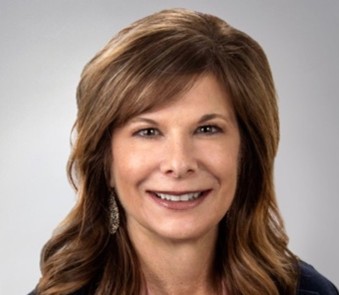 Julie Landspurg, Valley Metro’s manager for learning and organizational development, talked about the importance Valley Metro places on training. She said, “An organization without professional development opportunities is like a city without a park. You might have only 20 percent of the population taking advantage of them, but it’s really important to have them.”
Landspurg also said, “It’s important for an agency to have a professional development team who can administer programs. It doesn’t work if it’s just ad-hoc. Then everyone would be responsible, but no one would be responsible. That’s what happened before I was here.”
Likewise, every Valley Metro employee has both annual performance and professional development goals. She said that also has to be institutionalized; “otherwise, if it’s just when I have time, no one has time.”
Landspurg pointed out, “Training does not change behavior. Managers need to follow up with support and provide employees with feedback on how they are performing. You can’t assume training will give them all the skills they need.” She said training is more effective when employees talk to their supervisor about what they learned, and then the supervisors help them apply those lessons and offer support for their efforts.
She recognizes that “it’s difficult at best to retain good people” and thus the agency is training some employees who will only work at the agency for a short time. “It might be good for them, but not so good for us,” she said.
She described the agency’s three-pronged approach to training. The first is tuition reimbursement offered to employees. The second refers to how individual departments can sponsor professional development opportunities, such as attending conferences. The third and largest program is the agency-wide learning program which is managed by the Human Resource’s Training and Development division.
All agency directors and managers must participate in a Leadership Development program with sessions on topics such as holding effective meetings, creating a culture of feedback, and understanding legal issues in managing employees. The agency also offers a hybrid learning program for emerging leaders.
Valley Metro helps employees pursue professional engineering and PMP certifications. The agency also participates in the Eno/MAX program and Eno’s Transportation Mid-Manager Program, and it can send interested employees to the National Transit Institute courses.
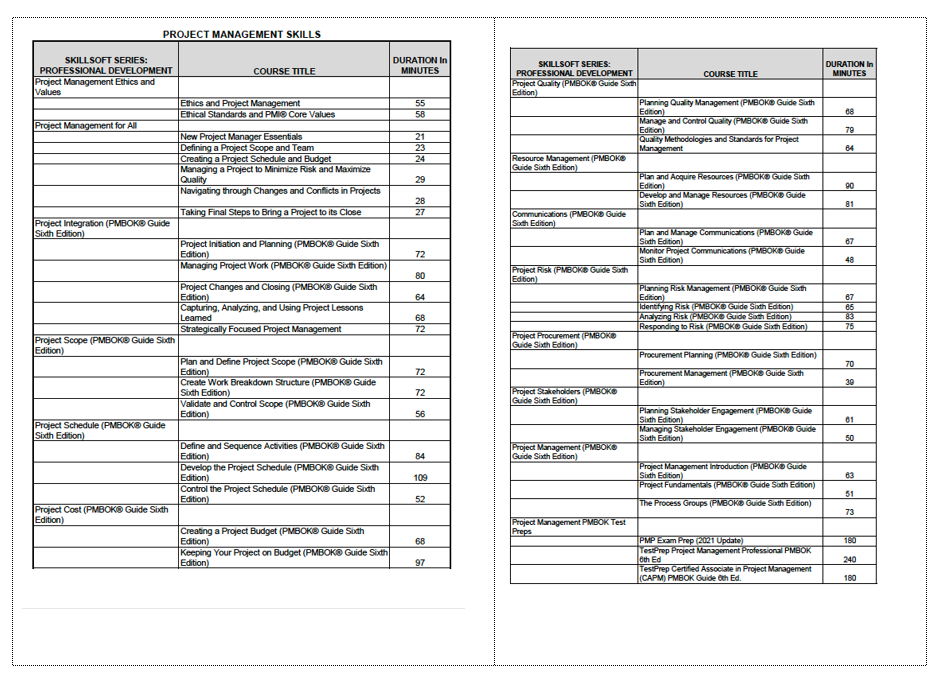
The agency subscribes to an e-learning library. The following page lists some of the online courses related to project management and PMP preparation. The acronym PMBOK refers to Project Management Body of Knowledge, a book published by the Project Management Institute which describes processes, best practices, terminologies, and guidelines.
When asked which transit agencies were role models for their training programs, Landspurg cited the agencies in Seattle, Pittsburgh and Atlanta.
Online Learning Courses Related to Project Management